INTRODUCTION
Every morning, hundreds of people walk through the doors of Tropico Café and order our signature coffee. They wrap their hands around the warm cup, take that first sip, close their eyes for just a moment — and something shifts. The noise of the day fades. The world slows down.
But what most people don’t know is that the cup they’re holding is the result of weeks of sourcing, days of testing, and years of refined craft. That single sip carries with it a story — of farmers on misty hillsides, of roasters obsessing over temperatures, of baristas who treat every cup like a small act of devotion.
Today, we’re pulling back the curtain. Here is the full, unfiltered story of how our signature coffee is made — from the very first seed to the last drop in your cup.
Chapter 1: It Starts With the Bean — Sourcing With Purpose
Most coffee journeys begin at origin, and ours is no different. Our signature coffee uses a carefully selected single-origin Arabica bean sourced from the high-altitude farms of Coorg, India — a region known for its rich, volcanic soil, cool misty mornings, and slow-ripening cherries that develop exceptional depth of flavor.
We don’t work with large commercial suppliers. Instead, we partner directly with small, family-run farms where the coffee cherries are hand-picked — only when they’ve reached perfect, deep-red ripeness. This selective hand-picking process takes longer and costs more, but the difference in cup quality is extraordinary.
Our sourcing philosophy is simple: great coffee begins with a relationship. We visit our farm partners every harvest season, understanding the soil, the altitude, the rainfall — all the invisible elements that shape what eventually lands in your cup.
“The best coffee isn’t made in the café. It’s made on the farm, months before a barista ever touches it.” — Head of Sourcing, Tropico Café
Chapter 2: The Wash — Unlocking the Bean’s Potential
Once the coffee cherries are harvested, they undergo a meticulous processing method. We use a washed (wet) processing technique, which involves removing the fruit pulp from the bean immediately after picking, then fermenting the beans in water for 24 to 48 hours before drying them on raised beds under the open sky.
This method produces a cleaner, brighter cup — one that allows the true character of the bean to shine through without interference from the fruit. It’s a labor-intensive process, but the result is a coffee that tastes crisp, transparent, and distinctly itself.
The drying phase alone takes 2 to 4 weeks. Farm workers turn the beans multiple times a day, ensuring even drying and preventing any spoilage. Patience, at every step, is the secret ingredient.
Chapter 3: The Roast — Where Science Meets Intuition
The green (unroasted) beans arrive at our roastery, and this is where our head roaster, has been roasting coffee for over a decade, and watching him work is like watching a musician perform — part technical precision, part deep intuition.
Our signature roast profile is what we call a medium-light roast, developed after over 40 test batches to find exactly the right balance. The beans are roasted at precisely 198°C for 11 minutes and 30 seconds. At around the 9-minute mark, you’ll hear the “first crack” — the moment the bean expands and sugars begin to caramelize. This is when the roaster’s attention must be completely focused.
What we’re chasing in the roast:
- Brightness — a lively, clean acidity that wakes up your palate
- Body — a smooth, medium weight that feels rich but not heavy
- Sweetness — natural caramel and brown sugar notes that develop during roasting
- Finish — a long, warm aftertaste with hints of dark chocolate and dried fruit
Every roast batch is cupped (tasted) by our team before it’s approved. If a batch misses the profile by even a degree, it doesn’t make it to the café floor. That’s the standard we hold ourselves to.
Chapter 4: The Grind — Precision in Every Particle
Once roasted, the beans rest for 48 to 72 hours — a process called degassing, where CO₂ released during roasting escapes the beans. Grinding too early results in an uneven, gassy extraction. Resting ensures a cleaner, more balanced shot.
When it’s time to grind, we use a commercial burr grinder set to an exact micron specification for our signature espresso. The grind size affects everything — too coarse and the water flows too fast, producing a weak, watery shot. Too fine and the water struggles to pass through, creating a bitter, over-extracted result.
Our baristas calibrate the grinder every single morning, dialing in the grind based on humidity, temperature, and even the age of the current batch. Coffee is a living product, and what worked perfectly yesterday may need a small adjustment today.
Chapter 5: The Extraction — 27 Seconds of Magic
Here is where everything comes together. The espresso extraction.
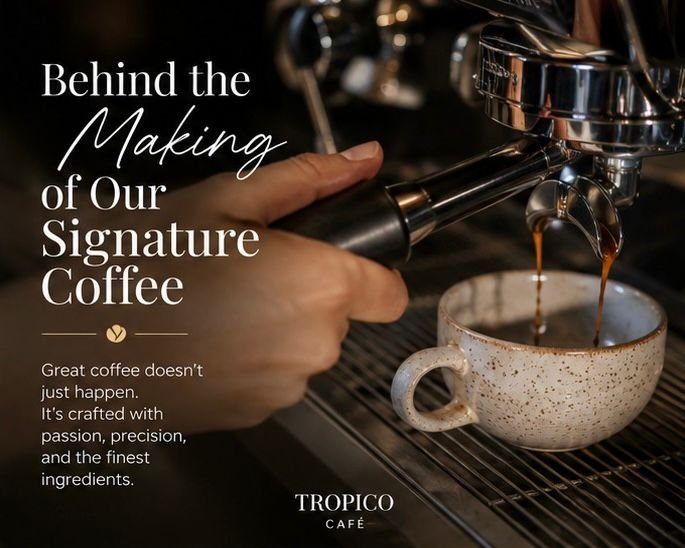
Our baristas dose exactly 18 grams of freshly ground coffee into the portafilter, tamp it with precisely 30 pounds of pressure, and lock it into our espresso machine — which maintains water temperature at a steady 93°C and applies 9 bars of pressure during extraction.
The ideal extraction window for our signature espresso is 25 to 27 seconds. In that narrow window, the hot water passes through the coffee puck in a perfectly controlled flow, pulling out the oils, acids, sugars, and aromatic compounds that make up the flavor of the cup.
The result — a thick, golden-brown shot with a rich, reddish crema on top — is the foundation of every signature coffee drink we serve.
“A great espresso shot is like a great sentence. Every element has to be in the right place, in exactly the right proportion.” — Tropico Café Head Barista
Chapter 6: The Milk — Texture Is Everything
For our signature lattes and cappuccinos, the coffee is only half the story. The milk matters just as much.
We steam whole-fat farm-fresh milk to exactly 62°C — warm enough to bring out the natural sweetness of the milk without scalding it, which destroys flavor and creates a thin, lifeless foam. Our baristas are trained to create microfoam — milk that has been stretched and textured to a silky, velvety consistency with tiny, uniform bubbles that integrate seamlessly with the espresso.
The pour is the final act. With a steady hand, our baristas pour the steamed milk into the espresso in one fluid motion — a technique that takes months to master — creating the signature latte art that crowns every cup.
Chapter 7: The Cup — A Ritual Worth Savoring
When your signature coffee finally arrives at your table, it represents hundreds of decisions made by dozens of people across thousands of kilometers. From the farmer who picked only the ripest cherry, to the roaster who dialed in the perfect curve, to the barista who pulled that 27-second shot — each person played a role in what you’re about to taste.
At Tropico Café, we believe coffee is not a commodity. It is a craft. It is a conversation between the land, the people who work it, and the person who ultimately drinks it.
So next time you take that first sip, we hope you taste not just coffee — but the care, the precision, and the passion that went into making it.
Closing — Come Experience It Yourself
Words can only take you so far. The real story is in the cup.
Visit Tropico Café and ask for our signature coffee — and now that you know the journey it’s been on, we think it might just taste a little more special.
We’d love to hear what you taste. Share your experience with us using #TropicoCafe on Instagram and tag us — we feature our favorite posts every week.
Written by the Tropico Café Team Category: Food & Beverage | Behind the Scenes | Artisan & Craft Tags: #SignatureCoffee #TropicoCafe #FromBeanToCup #CoffeeCraft #BehindTheScenes #SpecialtyCoffee #ArtisanCoffee #BrewMastery